Selling an Older Boynton Beach Home in 2026: Why the Roof Decides Your Buyer Pool Before the Price Does
August 27, 2026
August 27, 2026
Two houses list in Boynton Beach on the same week, priced within a few thousand dollars of each other. One goes under contract before the sign is even up straight. The other sits through three price reductions and two accepted offers that fall apart during underwriting. The difference usually has nothing to do with paint color or granite. It has to do with a roof permit date, an electrical panel brand, and a form most sellers have never heard of.
That is the reality for a lot of Boynton Beach's older housing stock right now. The city's median sale price sits in the low $400,000s as of August 2026, but that single number hides a split that matters more to a seller than the median ever will: whether a home can clear insurance underwriting cleanly, or whether it needs to be pre-cleared before it ever hits the market.
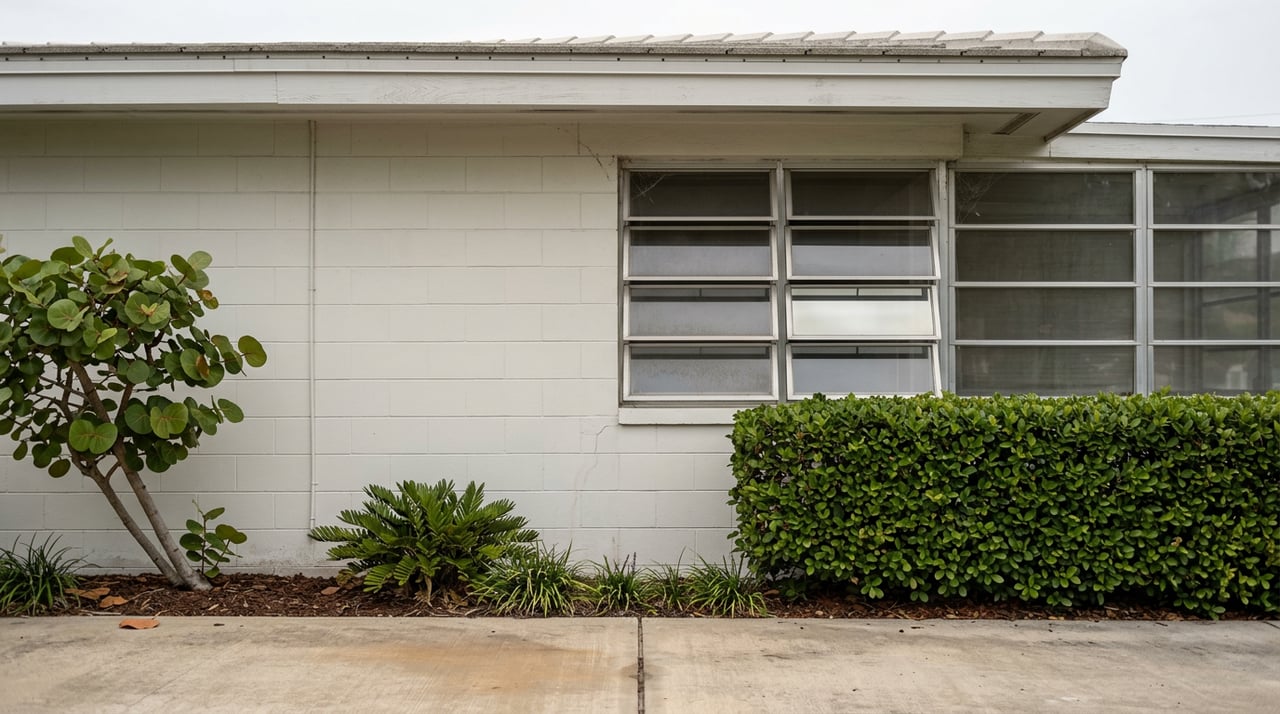
Boynton Beach grew in two distinct waves, and you can still read them on a map. The first wave, concentrated northeast of US-1 and around downtown, went up through the 1960s and 1970s. Hampshire Gardens, Sterling Village, and the original sections of Leisureville all date to that period, part of the growth spurt that also brought I-95 through the city. The second wave built out the western half of Boynton from the 1980s through the early 2000s, running as far as the Florida Turnpike. It includes Hunters Run Country Club's later phases, plus the western single-family subdivisions that now account for most of the city's re-roofing work.
Those two waves carry two different sets of underwriting risk, and the gap widens every year:
| 1960s-70s wave (near downtown, west of Federal Highway) | 1980s-early 2000s wave (western Boynton) | |
|---|---|---|
| Common roof type | Original metal or early concrete tile, often already re-roofed once | Concrete flat tile or architectural shingle on 20-to-25-year felt underlayment |
| Electrical | Aluminum branch wiring common, sometimes original panels | Copper standard, panels newer but approaching midlife |
| Windows | Single-hung jalousie windows in many original units | Later single-pane aluminum, some upgraded to impact |
| Where it stands in 2026 | Well past every insurance age threshold | Right at the 20-to-25-year replacement window carriers watch closely |
A house in Leisureville, built by the Campanelli Brothers between 1969 and 1987 across roughly 892 single-family homes, is now anywhere from 39 to 57 years old. Hunters Run, developed between 1979 and 2003 across 1,650 homes in 23 subcommunities, spans a wider range: some sections are squarely in the danger zone for a private carrier, others are only a few years past the point where a fresh roof condition report still buys time. Two houses on the same street in the same gated community can carry very different insurance risk depending on when the original roof went on and whether it was ever replaced.
The 4-point inspection covers four systems: roof, electrical, plumbing, and HVAC. It exists because carriers will not underwrite a home blind once it crosses a certain age, and the threshold most carriers use falls somewhere between 20 and 30 years old depending on the company. For Boynton Beach's older neighborhoods, that is not a hypothetical future concern. It is the inspection that shows up during almost every buyer's financing process once the home is more than two decades old.
The inspection is looking for specific, well-documented red flags: aluminum branch wiring from the 1960s and 1970s, which is a known fire hazard requiring either full replacement or COPALUM connector remediation; recalled panel brands like Federal Pacific or Zinsco; polybutylene or galvanized supply lines; and roofs that have aged out of their expected service life. A failed 4-point does not necessarily kill a deal, but it almost always triggers a renegotiation, a delay, or a buyer who quietly walks toward a newer listing instead.
Florida law gives homeowners real protection here, and understanding it changes how a seller should think about timing. Under Florida Statute 627.7011, an insurer cannot refuse to write or renew a policy solely because a roof is under 15 years old. Once a roof passes that mark, the burden shifts: a homeowner-paid inspection showing at least five years of remaining useful life is enough to keep a policy in force. In practice, most carriers want that condition report somewhere in the 15-to-20-year range, and private-market options narrow considerably past 20 to 25 years, according to a 2026 breakdown of the statute.
This is where the two Boynton Beach waves diverge sharply. A concrete tile roof installed during the western wave's building boom typically used felt or 30-pound underlayment rated for 20 to 25 years. The tile itself often still has decades of life left, but the underlayment beneath it does not, which means a roof that looks fine from the curb can still fail a carrier's condition threshold. For a 2,000-square-foot Boynton Beach home in 2026, replacing that assembly runs $25,000 to $42,000 for a concrete tile re-roof that reuses existing tile, or $13,000 to $22,000 for an architectural asphalt shingle replacement.
The upside for a seller who does the work: a new roof that meets current Florida Building Code standards can cut a buyer's homeowners premium by 20 to 40 percent, and the wind mitigation inspection form that documents those credits, form OIR-B1-1802, was updated effective April 2026 and stays valid for up to five years. A seller sitting on a form from before that update, or one that predates a roof replacement entirely, is leaving documented savings on the table that a buyer's lender will absolutely ask about.
The backdrop makes the timing matter more, not less. Citizens Property Insurance, the state's insurer of last resort, peaked at roughly 1.42 million policies in October 2023 and had fallen to around 336,000 by mid-2026 as private carriers re-entered the market. More than fifteen new insurers have started writing in Florida since the 2022 and 2023 reforms, and Citizens itself filed for an average statewide rate decrease near 8.7 percent for 2026 renewals. The state's insurance guaranty fund is even dropping its emergency 1 percent assessment two years early, starting in October 2026, a small but real signal that the worst of the volatility has passed.
None of that relief is evenly distributed. It flows to homes with documented roofs, current wind mitigation credits, and clean 4-point reports. A home without that paperwork is competing for a shrinking pool of willing carriers just as buyer financing gets pickier about exactly this kind of risk. That is very likely part of why Boynton Beach listings are taking longer to find buyers this year than in the tighter markets of a few years ago, and why more than three-quarters of active listings in the city have already taken at least one price reduction in 2026. A slower market and a stricter underwriting environment are not two separate problems. They are the same problem showing up in different places.
For a seller with a home built before roughly 2001, especially in Leisureville, Hunters Run, or one of the older sections near downtown, the sequence that avoids a stalled contract looks like this:
Does a new roof pay for itself before selling a Boynton Beach home? Not always in resale value directly, but it changes who can buy the house. A documented, current roof widens the pool of carriers willing to write a policy, which widens the pool of buyers whose lenders will approve the loan.
Is my Leisureville or Hunters Run home automatically uninsurable because of its age? No. Age alone cannot disqualify a roof under 15 years old, and even older roofs can stay insurable with a passing condition report. The risk is not the birth year of the home. It is whether anyone has documented its current condition.
Why does days on market matter more than price right now? Because in 2026, a stalled Boynton Beach listing is more often a financing problem than a pricing problem. A seller who solves the insurance question before listing is competing on price alone. One who doesn't is competing on price and hoping the buyer's lender cooperates.
Selling an older home in Boynton Beach in 2026 is less about finding the right buyer and more about making sure your house can clear the desk that buyer's lender never sees. If you own a home in Leisureville, Hunters Run, or one of the neighborhoods that grew up around downtown before the Turnpike pushed the city west, Omar Santamaria can walk through what your specific roof age and permit history mean for your timeline before you list. Let's Connect.
Stay up to date on the latest real estate trends.
Every move has a story. Whether you're relocating across the state, looking for more space, simplifying life, pursuing a new opportunity, or navigating an unexpected transition, the best moves aren't just about real estate. They're about creating a life that better reflects who you are today and where you want to go next. You don't have to figure it out alone. Let's create a plan built around your goals, your lifestyle, and the chapter you're ready to write next.